
AI can make publisher analytics faster and more accessible. You can ask a question in plain language, investigate a revenue change, summarize performance, or prepare a recommendation without navigating another series of dashboards. But how useful that experience is depends on everything happening beneath the prompt.
When the underlying data is fragmented, inconsistently defined, or disconnected from the way the business operates, AI can produce a clear-sounding answer based on unstable assumptions. Trusted AI architecture closes that gap. It connects publisher data, applies consistent business logic, separates calculation from interpretation, and preserves control as insights move toward action.
The question, then, is larger than which language model to use. You need to know whether the full architecture can produce answers that are consistent, explainable, reproducible, and useful enough to guide revenue decisions—and what your organization is genuinely ready to automate.
A language model is only one layer
Large language models make complex systems easier to interact with. You can ask a question naturally, receive an explanation, and shape the output for an analyst, salesperson, ad operations specialist, or executive.
That capability is different from establishing what the data means. An LLM does not inherently know whether two platforms define revenue the same way, whether a buyer appears under several names, which time zone governs a report, or how an ad-server event should be reconciled with an SSP or order-management record.
A trusted architecture assigns each job to the right layer. Data pipelines collect and prepare information. Mapping and enrichment connect entities across systems. Controlled calculations and data-science methods perform the analytical work. Generative AI helps users explore, interpret, and communicate validated results.
The publisher AI maturity curve
Trusted AI is built progressively. The publisher AI maturity curve describes how prepared your data, analytics, and operating environment are to support increasingly advanced AI capabilities.
The curve follows five stages:
Raw data → Normalization, cleansing and enrichment → Connected datasets and full analytics → Intelligent recommendations → Controlled automation
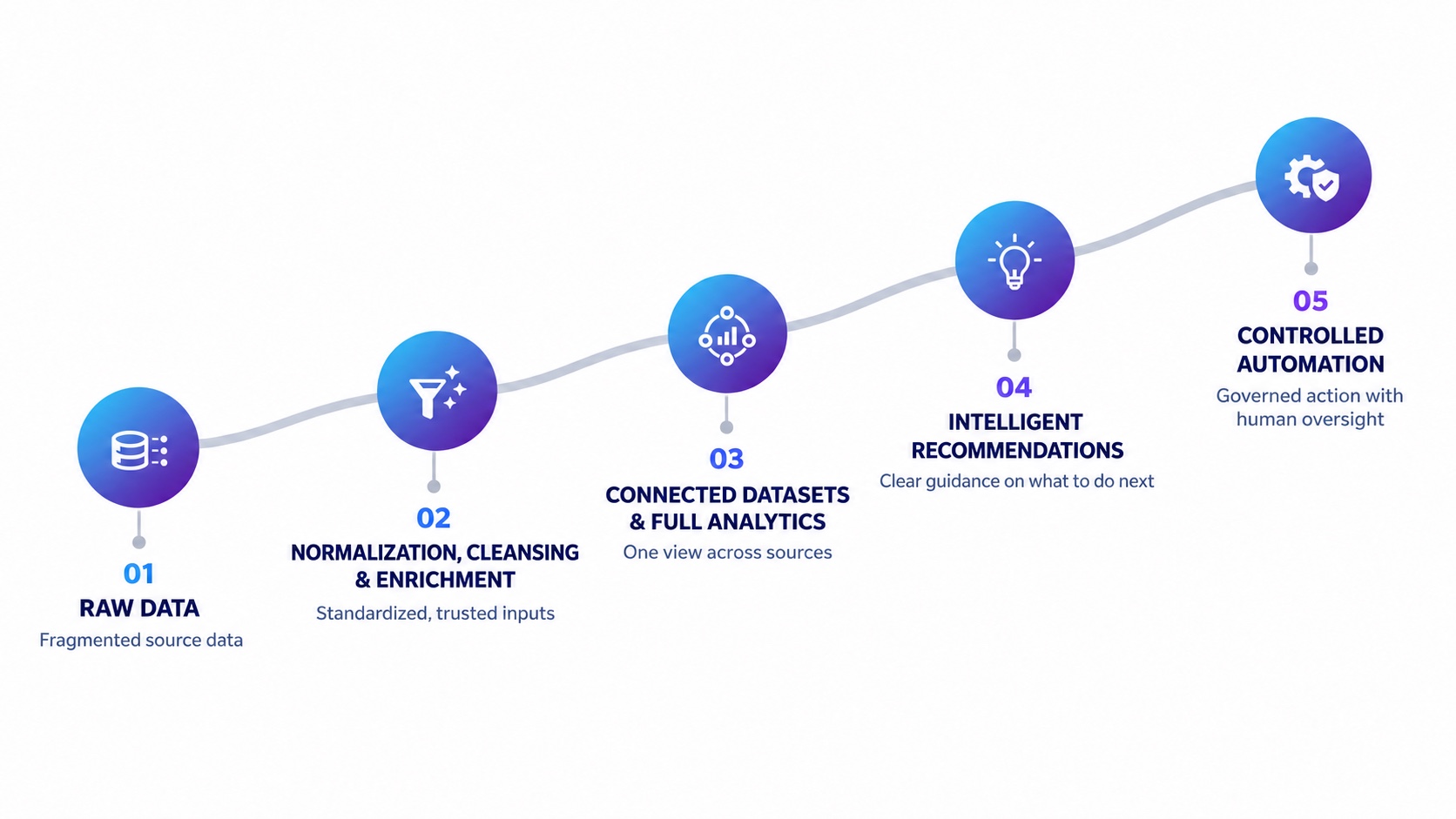
This is a capability path rather than a race toward maximum automation. Each stage depends on the strength of the stages beneath it. The goal is to understand where you are today, identify the gaps at that stage, and determine what you are ready to automate next.
Maturity can also vary across an organization. Your revenue analytics team may have well-connected data and repeatable calculations, while a sales or campaign workflow still depends on spreadsheets and manual reconciliation. Assessing maturity by workflow gives you a more useful picture than assigning one score to the entire business.
Stage 1: Raw data
Most publishers already have extensive data. Revenue, impressions, requests, bids, delivery, campaigns, buyers, inventory, and pricing signals may live across ad servers, SSPs, OMS platforms, CRM systems, financial tools, and market datasets.
At this stage, the challenge is access and consistency. Sources reflect different parts of the business and may use their own naming conventions, identifiers, dimensions, time zones, and definitions. The data may be available without yet being dependable enough to support shared analysis or AI-driven decisions.
Stage 2: Normalization, cleansing and enrichment
The next stage makes data decision ready. Records are cleaned, dimensions and metrics are normalized, identities are resolved, and the data is enriched with useful publisher and market context.
Publisher-specific rules also need to be applied consistently. Revenue, CPM, fill rate, delivery, and other core measures should mean the same thing wherever they appear. This is what allows two people asking related questions to receive compatible answers instead of rebuilding the logic each time.
Stage 3: Connected datasets and full analytics
Clean datasets become more valuable when they are connected around the business decisions your team needs to make.
A change in revenue, for example, may involve traffic volume, bid activity, buyer participation, price, fill, campaign delivery, inventory mix, or market movement. One source can show that something changed. Connected data helps explain why it changed and which response is appropriate.
At this stage, common buyers, campaigns, deals, inventory, and revenue events are mapped across systems. Governed calculations, queries, statistical methods, and purpose-built data-science models can then perform analysis using consistent definitions. The result is a shared analytical foundation that teams can use across applications and workflows.
Stage 4: Intelligent recommendations
Once the analytical foundation is reliable, AI can move from describing performance to recommending what to do next.
Controlled analytical layers identify drivers, test conditions, measure changes, and return structured findings. Generative AI can explain those findings, add relevant context, answer follow-up questions, and tailor the recommendation to the user. It might turn the same validated analysis into an analyst’s investigation, a seller’s account brief, or an executive recap.
A useful recommendation should show its supporting evidence and likely impact. Your team should be able to follow the path from source data through definitions and calculations to the proposed action. This combination of traceability and reproducibility makes the recommendation reviewable rather than simply persuasive.
Stage 5: Controlled automation
The final stage turns validated intelligence into action within defined boundaries.
The appropriate level of automation depends on the workflow. A recurring performance recap may run automatically. A low-risk, reversible optimization may operate within approved parameters. A decision affecting client commitments, pricing, inventory quality, or material revenue may retain explicit human approval.
Controlled automation therefore requires permissions, approval thresholds, monitoring, audit history, and reversal mechanisms. These controls make distinctions about risk and authority part of the system. They also allow automation to expand gradually as each workflow proves reliable.
How to identify where you are
You are ready for a stage when the capabilities beneath it work consistently for the workflow being assessed. A practical test is whether different teams can reach reproducible answers using shared definitions—and whether there is a clear process for turning those answers into action.
Ask:
- How are the required data sources cleaned, normalized, mapped, and enriched?
- How does the system resolve conflicting definitions or incomplete information?
- Can the same business question be answered consistently across users and teams?
- Which work is performed by business rules, queries, statistical models, machine learning, and generative AI?
- Can a result be traced to its supporting data, definitions, filters, and calculations?
- How are uncertainty, anomalies, and data-coverage limitations communicated?
- What permissions, approvals, monitoring, audit history, and reversal mechanisms govern actions?
These questions help reveal the next capability gap. If teams still reconcile definitions manually, the priority may be normalization. If the data is connected but recommendations are difficult to validate, the priority may be lineage and controlled analytical logic. If recommendations are dependable but every action remains manual, the next step may be a carefully governed automation workflow.
Build trust one workflow at a time
You do not need to move the entire organization through the curve at once. Start with one valuable, repeatable workflow: explaining weekly revenue movement, detecting anomalies, monitoring deal performance, improving campaign pacing, or preparing a client review.
Map the workflow from its source data to the decision or action it supports. Identify where definitions diverge, where people still reconcile information manually, which calculations require validation, and what level of oversight the outcome needs. Strengthening those layers creates immediate operational value and establishes a pattern that can extend to additional workflows.
The strongest publisher AI systems will combine connected data, publisher-specific expertise, controlled analytics, clear lineage, intelligent recommendations, and appropriate human oversight. That is what turns AI from an impressive interface into infrastructure a revenue team can rely on.
Common questions
What is trusted AI architecture for publishers?
Trusted AI architecture combines prepared and connected publisher data, governed business logic, controlled analytics, generative AI, and workflow controls. Together, these layers help teams produce analysis and recommendations that are consistent, explainable, and suitable for revenue decisions.
What does the publisher AI maturity curve measure, and how can publishers assess their stage?
The curve measures how prepared a publisher’s data, analytics, and operating environment are to support increasingly advanced AI capabilities. It progresses from raw data through preparation and connected analytics to intelligent recommendations and controlled automation.
Assess one workflow at a time. Look at whether its data is consistently defined and connected, whether results are reproducible across teams, whether recommendations can be traced to validated logic, and whether actions have appropriate controls. The first capability that remains inconsistent usually indicates the next maturity gap to address.
Why is an LLM alone insufficient for publisher analytics?
An LLM can interpret a request and explain a result, but it does not inherently know how each publisher system defines revenue, inventory, buyers, campaigns, or delivery. Those definitions and relationships need to be resolved through data preparation, mapping, and controlled analytical logic before generative AI interprets the findings.
What data should publishers prepare before using AI?
Publishers should start with the sources required for the workflow they want to improve. These may include ad-server, SSP, OMS, CRM, financial, inventory, and market data. The data should be cleaned, normalized, mapped across systems, enriched with useful context, and governed by consistent metric definitions.
How can publishers automate AI workflows safely?
Start with a repeatable workflow whose data and analytical logic have been validated. Define permissions, approval thresholds, monitoring, audit history, and reversal options based on the potential impact of the action. Lower-risk workflows can operate more independently as they prove reliable, while consequential decisions can retain explicit human approval.